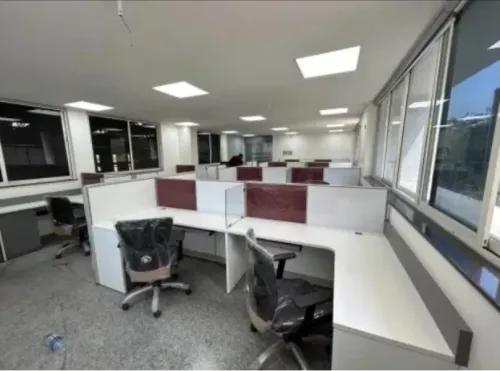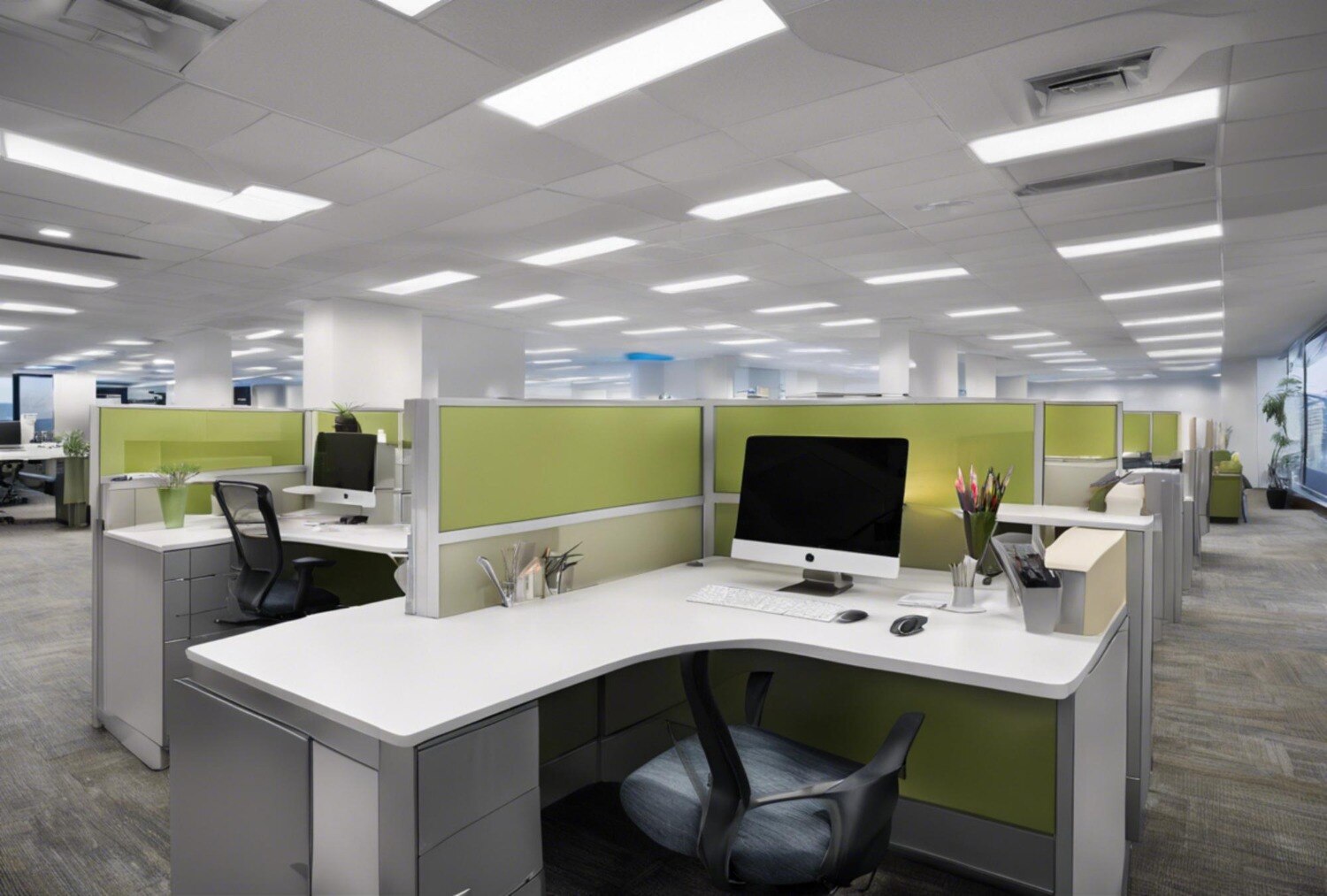
The right choice depends less on the desk footprint than on the refitted floor’s columns, circulation, services and the way your teams work. By the end, you will have a method to test both layouts, calculate the real installation effort and choose a system that remains practical after the next team move.
Key takeaways
- Measure doors, exits, aisles, services and columns before choosing desk shapes.
- Choose L-shaped desks for task separation; choose linear desks for flexible reconfiguration.
- Test both options with a scaled plan and one pilot bay.
- Compare installation, relocation, cable management and maintenance costs—not desk prices alone.
Measure the refitted floor before comparing desk shapes
Verify the refitted floor plate before comparing desk prices or shapes. Record the room length and width, column positions, façade and window lines, door swings, emergency exits, accessible routes, aisle widths, HVAC diffusers and return-air grilles, floor boxes, electrical points and data outlets.
- Mark the clear circulation route from the entry to every exit; do not count it as desk area.
- Add chair pull-back space, visitor clearance, pedestal opening, monitor-arm movement and access for CPU holders or under-desk power modules.
- Note dead corners beside columns, blocked diffuser paths and any outlet that a return panel would cover.
- Photograph existing floor boxes and cable routes before dismantling; relocation adds electrical and making-good work to the installed cost.
| Plan item | L-shaped effect | Linear effect |
|---|---|---|
| Column or dead corner | A return can trap unusable space or obstruct access | Straight runs usually stop cleanly before the obstruction |
| Floor box and data point | The corner and return need more cable planning | Repeated positions simplify connection and future moves |
| Aisle, exit or door swing | The return can narrow clearance | A straight top gives a clearer route |
| Window and daylight line | The return can create a shadowed work zone | Seats align more easily with the façade |
A scaled plan must show the complete usable footprint, not just the desktop rectangle. For l shape or linear workstations after office refit Pune projects, capture dismantling, shifting, disposal, floor-box adaptation and reinstallation as separate costs; an L-shaped system can need handed replacement parts that later become stranded inventory.
Match the layout to work patterns, not just seat count
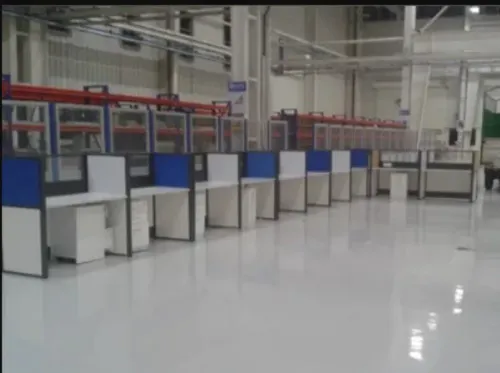
A team with frequent seat changes, shared projects and high headcount usually benefits from linear workstations. Identical orientations simplify hot-desking, supervisor sightlines and future expansion; one position can change without dismantling a handed corner. The linear versus L-shape workstations Pune decision should therefore start with churn and collaboration, not the number of desks alone.
| Team condition | Linear workstations | L-shaped workstations |
|---|---|---|
| Headcount | Growing teams needing tighter seating density | Stable teams with assigned seats |
| Work pattern | Frequent collaboration, supervision or hot-desking | Long periods of focused, individual work |
| Surface and storage | Separate pedestals or shared storage meet the need | Users need a continuous surface for drawings, files or equipment |
| Privacy | Open communication is valuable | A secondary zone supports confidential documents or calls |
| Change rate | Regular role changes and expansion | Rare moves; handed positions will remain useful |
| Meetings | Frequent team interaction at shared zones | Fewer interruptions around each assigned seat |
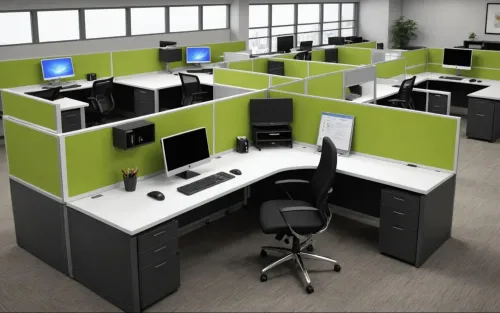
An L-shape is not justified by a larger desktop alone. Its return can block a door swing, create a dead corner beside a column or complicate access to power, data and air-conditioning paths.
Choose it only when the extra surface solves a real task problem and the refitted floor still preserves circulation, supervision and emergency egress.
Test both layouts with a scaled plan and a pilot bay
Prove the layout at full scale before ordering by testing a scaled plan and one installed pilot bay. The plan catches gross conflicts; the pilot exposes problems a drawing cannot, such as a chair striking an adjacent desk or a drawer blocking the aisle.
- Draw both options at the same scale, including desk tops, screens, pedestals, chairs, floor boxes, doors, columns, exits and collaboration areas. Mark the required circulation route with chairs pulled out and drawers open.
- Build one pilot bay with the actual desk, chair, monitor arms, screens, storage, cable trays and power modules. Test chair movement, monitor sightlines, cleaning access, drawer opening, floor-box access and outlet positions with the equipment connected.
- Check the electrical arrangement separately from the furniture. Record the source circuit, socket count, assumed load, power-data segregation and access for testing or replacement; reject hidden daisy-chained extension strips in cable trays.
- Ask users to perform normal work, a visitor meeting and a team handover in the bay. Record wasted reach, blocked supervision, noise, privacy and time needed to connect equipment.
If you plan to reconfigure L shape workstations, confirm left- or right-handed returns, true shared corners versus abutting tops, and reversible screens, modesty panels, cable spines and storage. Approve the layout only after the installed arrangement preserves an unobstructed accessible route, including occupied meeting zones and pulled-out chairs.
Compare the installed cost of each refit option
A desk quote is not an installed-cost comparison. Ask each supplier to price dismantling, disposal, shifting, services adaptation, installation, making-good and post-installation adjustment as separate lines.
| Option | Costs that can change the apparent price | Check before approval |
|---|---|---|
| L-shaped workstations | More dismantling, handed replacement parts, corner joints, return panels, cable trays and difficult moves around columns; reinstallation takes longer when existing modules are reused. | Confirm left- and right-hand components, corner sizes, lift access and disposal quantities. |
| Linear workstations | Fewer corner parts and faster installation, but shared runs may need extra screens, end panels, linking kits and cable access. | Price every screen, pedestal, monitor arm, CPU holder and under-desk power module. |
| Either layout | Floor-box adaptation, new sockets, data outlets, power-and-data segregation, shifting, uneven-floor correction, waste removal and wall or floor making-good can erase the desktop saving. | Require source circuits, socket counts, load assumptions and testing access; reject hidden daisy-chained extension strips. |
For office refit furniture in pimpri chinchwad, add site allowances for production dust, trolley movement, loading-bay routes, restricted delivery windows, lift dimensions and fragile low-level panels. A recess that collects dust or a tray that blocks cleaning access creates operating cost after installation, not just a higher day-one bill.
Have Vedika Interior or another bidder measure the route and price a pilot bay before the full order. Compare the signed total for dismantling, services, installation and adjustments, not the cheapest workstation surface.
Related products
 | Modular Office Workstation Manufacturer in Pune – Designed for Comfort, Space, and Efficiency An L-Shape Office Workstation is a smart and ergonomic solution for modern offices... View product → |
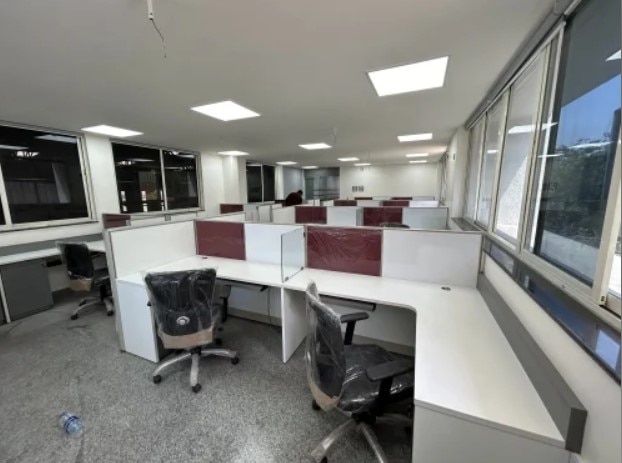 | Modular Office Workstation Manufacturer in Pune – Efficient Layouts for Modern Offices A Linear Workstation is a practical and space-efficient office furniture solution... View product → |
Protect the investment through maintenance and future changes
Inspect the corner before it becomes a repair. L-shape office workstation maintenance needs more attention at the return joint, cable spine and pedestal interface than a straight linear top because these points collect dust, absorb chair impacts and move out of alignment during relocations.
- Tighten fasteners and check levellers for rocking or uneven joints.
- Inspect edge banding for lifted sections that can admit moisture or cause cuts.
- Check cable-tray fixings, partition connectors and screen mounts for looseness.
- Confirm drawers open fully without striking legs, returns or circulation routes.
- Remove stored cartons, bags and chairs from egress paths and accessible routes.
Specify adaptability before ordering. To reconfigure L-shape workstations, record whether each return is left- or right-handed, whether the corner uses a shared connector or two abutting tops, and whether screens, modesty panels, cable trays and pedestals can change sides. Proprietary corner fittings and one-sided cable spines can make a planned move cost more than replacement.
Keep linear workstations adaptable by choosing repeatable desk widths, detachable screens and storage that can move independently. Ask for a component schedule and retain spare connectors, levellers and matching edge trim.
Cable trays do not replace electrical design. Label the source circuit, socket count, load assumptions and power-data segregation, and provide access for testing. Reject hidden daisy-chained extension strips. Before signing off either layout, test open drawers, pulled-out chairs, occupied collaboration areas and door swings against the final installed plan.
Frequently asked questions
What should you measure before choosing L-shaped or linear workstations?
Record the floor length and width, columns, windows, door swings, emergency exits, accessible routes, aisle widths, HVAC diffusers, return-air grilles, floor boxes, electrical points and data outlets.
When are linear workstations better than L-shaped workstations?
Choose linear workstations when teams need straightforward circulation, shared benching, higher layout flexibility or frequent reconfiguration.
When are L-shaped workstations better than linear workstations?
Choose L-shaped workstations when users need a larger personal work surface, task separation, corner storage or space for monitors and paperwork.
How can you compare the installed cost of each refit option?
Compare desks, screens, pedestals, cable management, power and data changes, delivery, installation, floor repairs, relocation time and future reconfiguration.
Related products
 | Modular Office Workstation Manufacturer in Pune – Flexible, Modern Solutions for Productive Workspaces An Office Modular Workstation is designed to create efficient, organized,... View product → |
 | Modular Office Workstation Manufacturer in Pune – Smart, Flexible Solutions for Modern Offices A Modular Workstation is designed to create efficient, organized, and adaptable... View product → |
Keywords