Choosing between two and four shelves depends less on the catalogue label than on usable pair capacity, shoe type, wall width, and arrival peaks. By measuring the installation area and calculating real demand, you can select a rack that remains accessible, stable, cleanable, and suitable for Pune’s monsoon conditions.
Key takeaways
- Choose two shelves for small teams and spread-out arrival times.
- Choose four shelves for larger teams, visitors, or shift-change demand.
- Measure shelf width, depth, spacing, and access clearance before ordering.
- Ask suppliers for load ratings, wall-fixing details, and corrosion protection.
Two Shelves or Four: Which Rack Fits Your Office Pattern?
Choose two shelves when one small team uses the rack, visitor numbers are low, and employees arrive across a wide time window. Choose four shelves when headcount, visitor flow, or shift changes create a concentrated demand for storage.
For a metal or two shelf shoe rack for corporate offices Pune, compare usable pairs per linear metre, not the shelf count alone.
| Option | Best fit | Watch before choosing |
|---|---|---|
| Two shelves | Small offices, occasional visitors, one shift, and a footwear policy limited to formal shoes or sandals | It needs more wall width or a second unit as headcount grows; peak arrivals can create queues and floor clutter |
| Four shelves | Larger teams, frequent visitors, multiple shifts, and arrival periods before opening or after shift changes | Confirm the clear opening between shelves; safety shoes and high-ankle footwear can collide with low shelves |
| Two shelves | Offices with a narrow wall but modest daily occupancy | Check whether the rack can hold the morning peak without shoes being left underneath |
| Four shelves | A wider wall section with a fixed storage zone | Leave access for cleaning, doors, skirting, and circulation; extra height does not help if users cannot reach it safely |
Count employees present at the same time, not total payroll. Add visitor pairs and the overlap between shifts, then include spare positions for peak arrival periods. A strict no-outdoor-footwear policy justifies more capacity; a mixed policy needs wider, stronger shelves for safety shoes and boots.
In this office shoe storage comparison Pune, wall width, clear shelf spacing, footwear type, and queue risk matter more than catalogue height.
Measure Usable Capacity, Not the Shelf Count
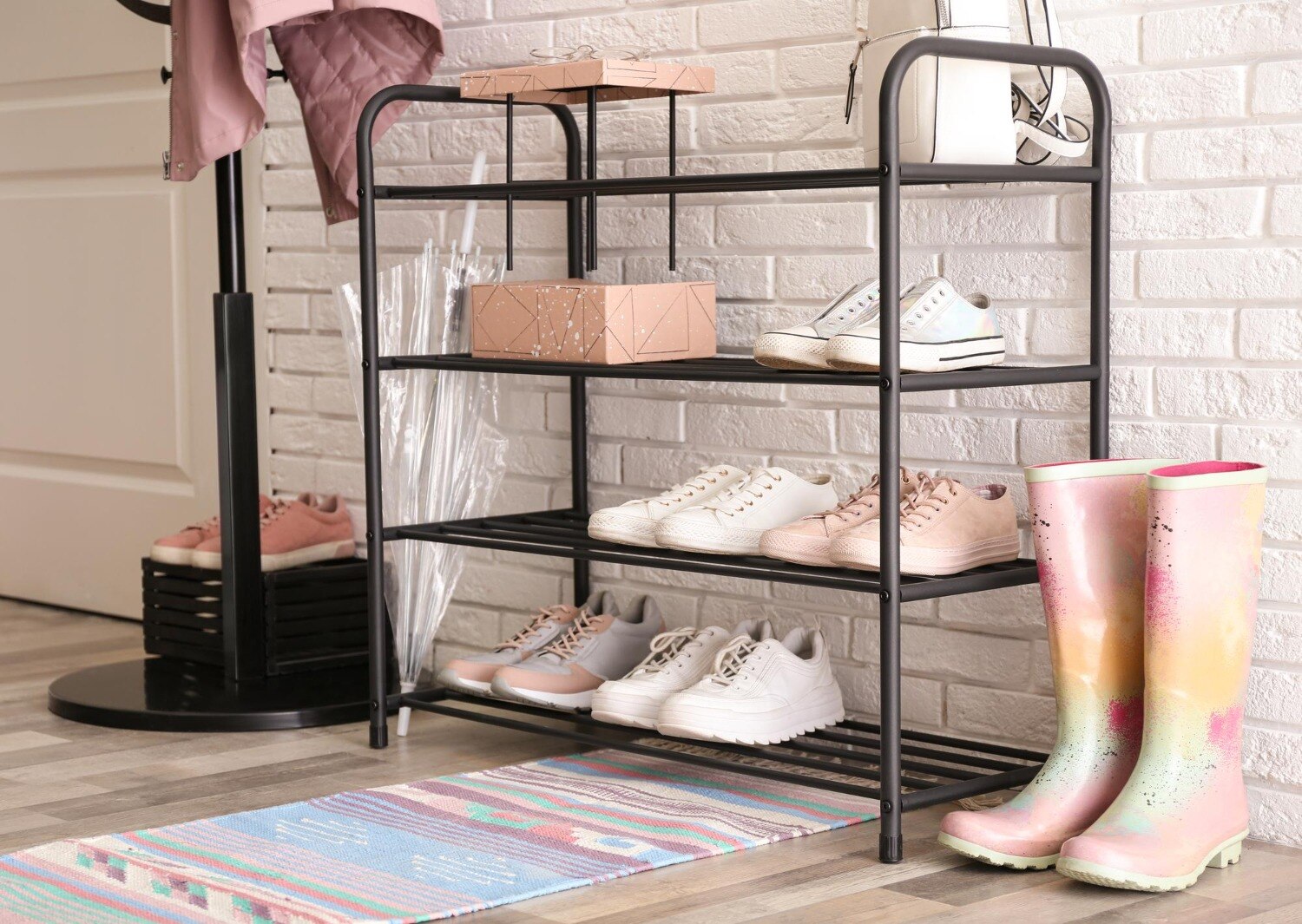
Capacity is usable pairs per linear metre of shelf, not the number of shelves printed in a catalogue. A four-shelf metal shoe rack in Pune can hold fewer practical pairs than a two-shelf rack if its shelves are narrow, openings are too low, or bulky footwear occupies each level.
1. Record the overall width, height and depth, then measure usable shelf width between the side frames. Exclude end gaps, bends and unusable corners from the pair calculation.
2. Measure the clear vertical opening above every shelf. Allow about 150–180 mm for formal shoes, 200–240 mm for safety shoes and 280–350 mm for high-ankle footwear. External rack height does not prove that the shoes will fit.
3. Check the required wall clearance, skirting-board projection, door swing and cleaning access. A rack that fits the wall drawing can still block circulation or prevent a mop from reaching the floor.
4. Calculate each shelf separately: usable shelf width divided by the width occupied by one pair, rounded down. Multiply by the number of shelves only after checking that every opening suits the footwear mix.
| Footwear type | Planning width per pair | Approximate pairs per metre |
|---|---|---|
| Formal shoes | 220–260 mm | 3–4 |
| Sandals | 170–220 mm | 4–5 |
| Safety shoes | 260–330 mm | 3–4 |
| High-ankle footwear | 330–450 mm | 2–3 |
Confirm the estimate with representative employee footwear and count toe-out storage, not an idealised empty shelf. A two-shelf unit may need a second rack during peak arrival periods; compare total usable positions, not shelf count.
Match the Rack to Footwear, Loads, and Wall Construction
A two shelf wall mounted shoe rack Pune office installation must be rated for the footwear people actually bring, not an assumed pair of lightweight formal shoes. Safety shoes are heavier and bulkier; boots need greater clear height, while helmets require a stable shelf or dedicated hooks rather than a crowded shoe level.
| Footwear | Check before approval | Specification to request |
|---|---|---|
| Formal shoes | Usually fit standard openings and side-by-side placement | Usable shelf width and clear vertical opening |
| Safety shoes | Add weight, mud and metal debris | Shelf load, cleanable lower shelf, corrosion-resistant finish |
| Boots | Need extra height and depth | Clear opening, usable depth and tested pair count |
| Helmets | Can roll or occupy more space than shoes | Shelf restraint, hooks, or a stated helmet capacity |
| Mixed footwear | Dress-shoe counts overstate capacity | Test with the actual mix and record usable pairs per shelf |
The purchase order must name the base metal, sheet or tube dimensions, weld or fastener construction, pretreatment, finish, shelf load, overall dimensions, tolerance and anchoring method. “Metal” or “steel” alone does not make two quotations comparable.
State the wall substrate—reinforced concrete, brick, blockwork or drywall—and require approved anchor types, fixing locations, edge distances, level installation and minimum installation load. Catalogue capacity is incomplete: users pulling footwear from one side create pull-out forces at the upper fixings.
A two shelf wall mounted shoe rack Pune buyer should reject any design whose safe load depends on unknown wall construction or generic screws.
Compare Wall-Mounted Storage with Other Office Options
Choose wall-mounted storage when preserving floor area matters more than relocation. It keeps the floor clear for mopping and reduces trip hazards, but installation depends on the wall, anchors, and accurate levelling. A loaded rack is not automatically safer: users pulling shoes from one side create pull-out forces at the upper fixings.
For an office shoe storage comparison Pune facilities teams can use, compare the options by practical trade-offs:
| Option | Floor footprint and access | Capacity, security, and disruption |
|---|---|---|
| Wall-mounted metal rack | Preserves floor space; easy to clean below | Good for defined pair capacity; needs substrate checks, approved anchors, and wall damage if relocated |
| Freestanding metal rack | Uses floor area; easiest to move and service | Suits changing teams and shifts; open footwear remains accessible |
| Wooden cabinet | Largest footprint; cleaning takes longer around doors and plinths | Better visual concealment and basic security; costly to move and can hide damp footwear |
| Plastic shelving | Light and easy to reposition | Handles light office shoes; check deflection and cleaning needs before storing heavy safety shoes |
| Open cubbies | Requires substantial floor or wall width | Fast identification and access; visible clutter and little security |
| Under-desk storage | Uses otherwise wasted space | Fits personal pairs, not shared capacity; obstructs legroom and complicates cleaning |
Select wall mounting only after identifying reinforced concrete, brick, blockwork, or drywall. Request the anchor type, fixing locations, edge distances, and minimum installation load; catalogue capacity alone cannot validate an unknown wall.
What to Request from a Pune Commercial Rack Supplier
Request a production drawing before approving a quotation. It should show overall width, height, depth, shelf spacing, usable shelf width, clearances, sheet or tube dimensions, welds or fasteners, tolerances, and anchoring points.
A commercial shoe rack manufacturer in Pimpri-Chinchwad should also provide a material and finish declaration naming the base metal, pretreatment, coating system, and intended indoor-use conditions.
Compare supplier evidence against the rack you are buying:
| Evidence | Two-shelf rack | Four-shelf rack |
|---|---|---|
| Clear opening | Check space for formal shoes and safety shoes | Check every opening; external height can overstate usable capacity |
| Wall load | Confirm load transferred through each anchor | Confirm combined shelf and anchor load when all levels are occupied |
| Installation | Identify concrete, brick, blockwork, or drywall | Specify approved anchor type and minimum installation load |
Ask for a physical sample inspection and a shelf load test report or engineering calculation. A four shelf metal shoe rack Pune buyer should reject a pair-count claim that omits usable shelf width and vertical opening.
Put these terms in the purchase order:
- Delivery, assembly, drilling, levelling, and wall repair responsibilities
- Spare shelves, fasteners, and replacement-part availability
- Warranty period, response time, and exclusions for overloading, corrosion, relocation, and incorrect anchoring
Vedika Interior can be assessed against this checklist rather than location alone; local availability does not prove structural capacity or coating durability.
Related product
 | Wall Mounted Shoe Rack Metal 4 Shelves Wall Mounted Shoe Rack MS Metal Wall Mounted Shoe Rack Manufacturer in Pune – Durable, Space-Saving Storage Solution An MS Metal Wall Mounted Shoe Rack is a practical and... View product → |
Frequently asked questions
Should a Pune corporate office choose a two-shelf or four-shelf shoe rack?
Choose two shelves for a small team with low visitor traffic and staggered arrivals. Choose four shelves when headcount, visitors, or shift changes create concentrated storage demand.
How do you measure a shoe rack’s usable capacity?
Measure the internal shelf width and depth, vertical clearance between shelves, number of usable pairs per shelf, and the access space in front of the rack.
What should you check before fixing a shoe rack to an office wall?
Check the wall construction, anchor type, rack load rating, shoe dimensions, shelf spacing, and whether the fixing method suits the masonry, concrete, or partition wall.
How does wall-mounted shoe storage compare with other office options?
Wall-mounted racks save floor area and simplify cleaning, while freestanding racks offer easier relocation and higher capacity. Compare access, stability, security, and installation effort.
What should you request from a commercial shoe rack supplier in Pimpri-Chinchwad?
Request exact dimensions, usable capacity, steel thickness, load rating, finish specification, corrosion protection, wall-fixing hardware, installation scope, and delivery details.
Keywords