A growing office quickly outgrows a table chosen only for its appearance: headcount rises, meetings become hybrid, and client or investor discussions compete for the same room. Use meeting frequency, usable seating, room clearances, construction, technology, and future reconfiguration to choose a table that remains practical as the business changes.
Key takeaways
- Size the table for your busiest normal week, not occasional large meetings.
- Count usable seats after allowing space for chairs, laptops and circulation.
- Choose shape and construction based on meeting style, room size and daily wear.
- Specify finish, cable access, delivery checks and service terms in writing.
Match the table to how your office is growing
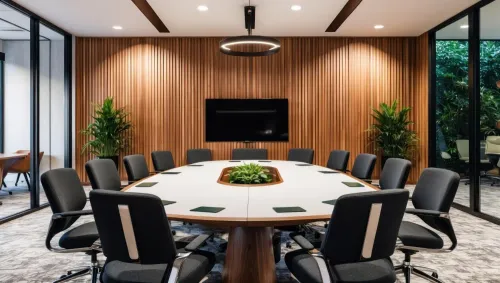
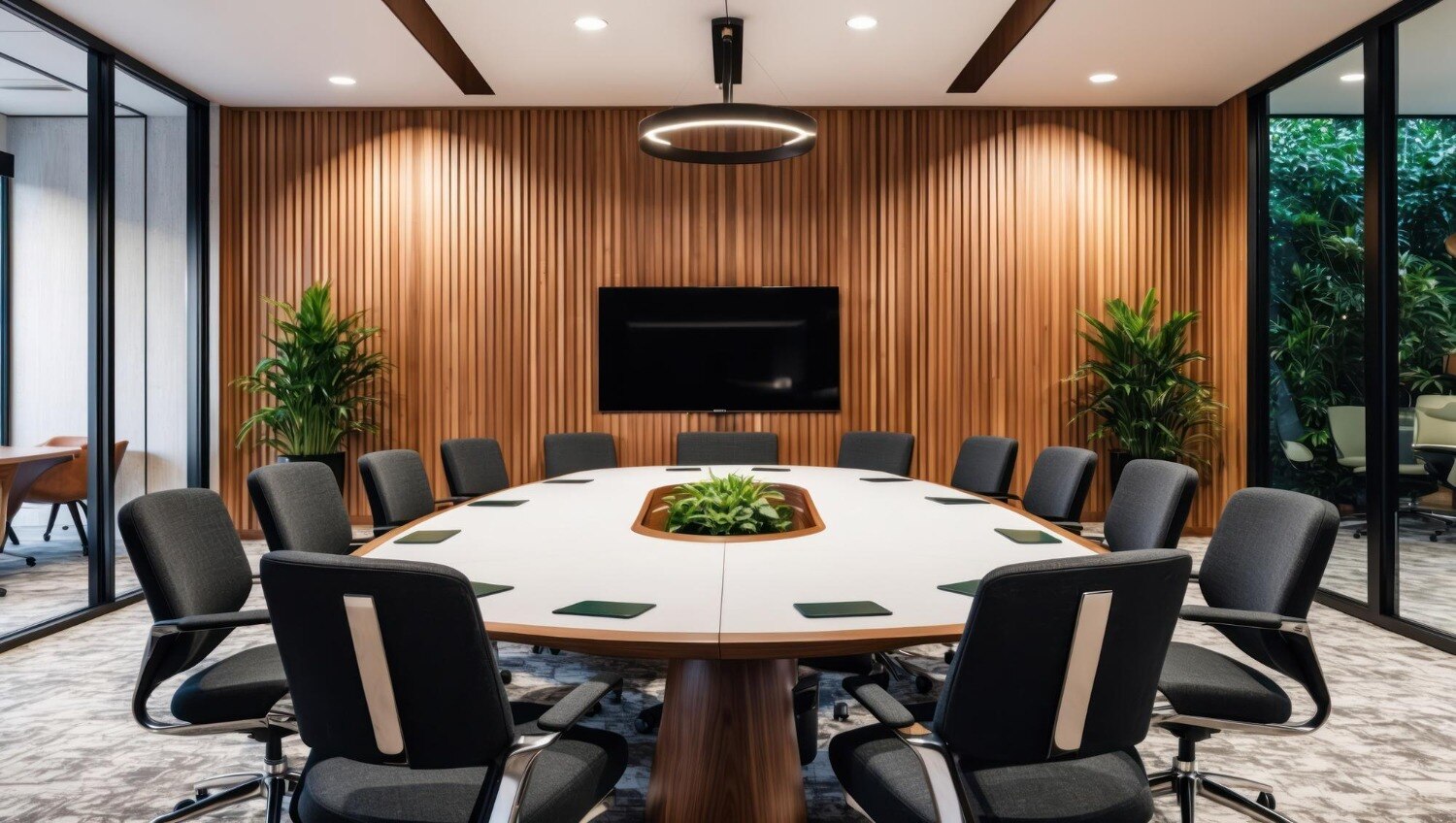
A wooden table suits a growing office when meetings are regular enough to justify a dedicated room, but the format still needs to evolve. Choose the table around your busiest normal week, not an annual investor presentation that leaves empty seats every day.
| Meeting pattern | Suitable table decision | Change it when |
|---|---|---|
| Small internal meetings | Use a compact rectangular or boat-shaped table with a veneer-faced engineered top. It gives consistent dimensions and leaves room for daily laptop work. | Teams routinely exceed the available comfortable seats. |
| Client and cross-functional meetings | Choose a wider wooden table with clear sightlines and a finish that tolerates frequent use. A solid-timber edge adds repairability where the room receives heavy traffic. | Chairs, displays, or visiting teams begin competing for space. |
| Hybrid meetings and investor discussions | Select a shape that keeps every participant visible to the camera and screen. Plan for the larger group only if those meetings occur often enough to occupy the room productively. | The room is regularly rearranged, or attendance varies sharply between meetings. |
This is the practical case for wooden conference tables for growing businesses: the surface remains presentable through repeated use, while the room can support more formal meetings as the company gains clients and staff.
If headcount rises faster than meeting demand, buy a table that supports comfortable expansion rather than the largest top the room can hold.
Size for usable seats, not the tabletop’s label
Plan by usable chair positions: allow 600–750 mm of table edge per seated person, then subtract space lost to legs, pedestals, cable boxes and modesty panels. A drawing showing six chairs can deliver only four comfortable working positions.
1. Measure the room’s internal length and width, including columns, radiators and door swings. Keep a 900–1,200 mm circulation route around the table; 1,200 mm works better where people pass behind seated colleagues.
2. Select the top size from the required seats. A 1,800 mm table suits two people per side; 2,400 mm suits three per side; 3,000 mm suits four per side when the understructure leaves the full edge usable. Allow about 1,000–1,200 mm width for laptops, documents and a central cable route.
3. Check the ends separately. A table leg or pedestal can remove an end seat, while a fixed screen or wall can make that position unusable. Mark every chair centre on the floor plan before approving the design.
4. Reserve accessible space instead of treating it as leftover clearance. The ADA benchmark is 760 by 1,220 mm of clear floor space, with knee clearance of at least 685 mm high, 760 mm wide and 485 mm deep; verify your local code before using those figures as a legal standard.
5. Check the viewing distance to the display, door clearance and the route to power. A conference table for growing office use fails quickly when chairs block the entrance or laptop cables cross walkways. Modular linked tops can add seats later, but specify connector positions and replacement sections now.
Choose the construction and shape that fit the work
Select solid timber when repairability and a substantial edge matter; select veneered engineered panels when dimensional consistency and a large, stable top matter more. The benefits of wooden conference tables include repairable surface damage, possible refinishing, and less glare than polished glass, but a thin veneer cannot withstand repeated sanding.
| Option | Best fit | Watch for |
|---|---|---|
| Solid timber | Executive discussions and long service life | Seasonal movement across the grain; acclimatise it before installation |
| Veneered MDF or particleboard | Frequent meetings and large consistent tops | Limited sanding depth; seal the underside and every cut-out |
| Glass or glossy laminate | Design-led client rooms and easy wipe-down | Glare, fingerprints, and greater visual or acoustic reflection |
| Rectangular | Presentations, screen viewing, and formal seating | Fixed hierarchy and less conversational contact at the ends |
| Oval or boat-shaped | Mixed discussion with clear sightlines | Curved edges reduce usable surface near corners |
| Round | Small equal-participation meetings | Poor fit for larger groups and central cable access |
| Linked modules | Offices that split or expand meeting areas | Alignment joints, connector wear, and replacement colour differences |
For Pune or Pimpri-Chinchwad, specify the panel construction, edge profile, finish system, cable routing, load rating, warranty, installation method, and replacement-part availability. Local stock can shorten delivery, but it does not prove timber quality or moisture control.
A hard wooden top will not solve echo in a glass-and-concrete room. Add absorptive ceiling or wall treatment, and use acoustic screens when speech clarity matters; choose the tabletop for work first.
Design the table for hybrid meetings and daily maintenance
Put power and data within reach of every meeting position. Specify the location and capacity of cable ports, under-table trays, floor boxes, and power modules before approving the tabletop; otherwise laptop, camera, and monitor leads can cross walkways or stop short of the central connection.
Ask for these details in the furniture and electrical specification:
- A power module with the applicable electrical listing or certification, plus its approved installation method. A neat cut-out is not proof that the complete table-and-power assembly is compliant.
- A low-sheen finish for daily use. Compare sample panels under the room’s actual lights and request resistance data for abrasion, stains, cleaning chemicals, and heat.
- A sealed edge, underside, and every cable cut-out. Wood gains and loses moisture as indoor relative humidity changes, with greater movement across the grain.
- Acclimatisation at the installation site before assembly, especially in Pune and Pimpri-Chinchwad. Sealing reduces movement-related problems but cannot eliminate them.
A wooden top will not solve a noisy room. Its hard surface can reflect speech and increase reverberation when glass, bare walls, and hard flooring surround it.
Add absorptive ceiling or wall treatment and acoustic screens where speech intelligibility matters; choose finishes that wipe clean without abrasive pads or harsh chemicals, and inspect cable covers and edges during routine cleaning.
Turn local sourcing into a measurable buying specification
A local quote is useful only when it becomes a measurable specification. If you are comparing a wooden meeting table Pune suppliers quote, or an office conference table in Pimpri-Chinchwad, do not treat proximity as proof of timber quality, moisture control, or electrical compliance.
Ask every supplier to state:
- Top construction: solid wood, veneer over plywood, or particleboard; include panel thickness and edge-banding material.
- Overall length, width, height, usable chair positions, knee clearance, and the space consumed by legs, pedestals, modesty panels, and cable boxes.
- Finish system, sheen, edge profile, and whether the underside, cable cut-outs, and other exposed surfaces are sealed.
- Acclimatisation period before installation and the indoor relative-humidity range the supplier used for the design.
- Cable-routing layout, power-module make and certification or listing, installation method, and access for replacement.
- Safe working load, delivery date, installation scope, warranty duration, and availability of matching panels, hardware, and replacement parts.
- Composite-wood formaldehyde-emission class or named test method; reject “eco-friendly” without evidence.
A local manufacturer such as Vedika Interior can simplify site measurement, delivery, installation, and future repairs, but require these details in the quotation. Compare written specifications, not showroom appearance. A generic socket cut-out proves nothing about the safety of the complete table-and-power assembly.
Related products
 | Office Conference Table Manufacturer in Pune – Timeless Elegance for Professional Spaces A Wooden Conference Table brings warmth, sophistication, and authority to any... View product → |
 | Office Conference Table Executive Office Conference Table Manufacturer in Pune – Where Leadership Meets Design An Executive Office Conference Table is the centerpiece of a professional meeting space,... View product → |
Frequently asked questions
How should a growing office match a conference table to its growth?
Choose a table around your busiest normal week and planned team growth, while avoiding seats that remain empty during routine meetings.
How many people can a conference table seat comfortably?
Count usable seats after allowing room for chairs, laptops, documents and movement rather than relying only on the tabletop’s advertised capacity.
Which conference table shape and construction suit office work?
Select the shape according to room dimensions and meeting format, then compare construction for stability, durability, repairability and daily use.
What should you specify for hybrid meetings and maintenance?
Plan cable access, power and camera sightlines, then specify the finish, cleaning method, edge protection and maintenance responsibilities.
How can local sourcing become a measurable buying specification?
Record dimensions, materials, finish, delivery requirements, inspection checks, warranty terms and service response commitments so suppliers can be compared consistently.
Related products
 | Office Conference Table Premium Office Conference Table Manufacturer in Pune — Elevate Your Boardroom A Premium Office Conference Table is more than just a piece of furniture — it’s the centerpiece of your... View product → |
 | Office Conference Table Manufacturer in Pune – Defining Style, Comfort, and Performance Premium Conference Tables are the foundation of productive meetings and impactful... View product → |
Keywords